Written in collaboration with vets



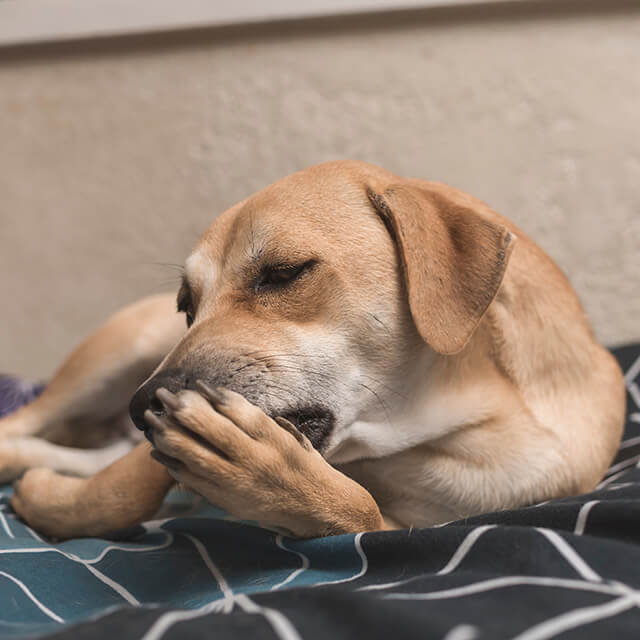

Have you noticed your dog licking their paws a lot? While some light licking is normal for happy hounds, excessive chewing or repetitive licking of their paws could signal a potential health problem with your pup.
If you’re wondering ‘Why does my dog keep licking their paws?’, we’re going to break down the main causes, warning signs of anything serious, and what to do next.
Paw licking is common pet behaviour to help clean dirty paws, or between toes, as part of their grooming routine. Some dogs do this after walks, to remove dirt or debris, or even to help them wind down after a busy day playing.
Licking that is repetitive, intense, or causing redness, hair loss, or damage to your dog needs investigating and can be a sign of something more serious.
This is why looking at your puppy’s paws regularly, and observing their behaviour, is essential for any dog parent, as these habits can be carried into adulthood and make conducting checks that much easier.
If your dog is licking their paws more than usual, there may be another reason behind the behaviour.
The reason why your dog keeps licking its paws could be one of the following nine:
Like humans, dogs may be allergic to things like pollen, dust, grass, washing powders, cleaning solutions, mould, or certain foods. These allergies can leave their skin feeling itchy and irritated. Your dog may overly lick their paws to help relieve discomfort.
Dog allergies are actually the most common cause of excessive paw licking in dogs.
Some forms of bacteria or fungus can inflame your dog's skin. Your pup may lick infected areas to ease swelling and inflammation.
Bacterial or yeast infections can both develop as a secondary issue when a dog repeatedly scratches or licks an already irritated area. While not the initial cause, these infections can cause even more scratching from your dog.
Persistent redness, odour, crusting, or thickened skin between the toes may indicate infection, and a vet can advise on the best course of action if this is the case.
Fleas, ticks, and mites can cause irritation to your dog's skin, particularly on the feet and lower limbs where their blood vessels are close to the surface. Your pup may lick their paws more often to help soothe any itching.
If the licking started suddenly after time spent outdoors, it’s certainly worth checking your dog for parasites.
Cuts, scrapes, grass seeds or thorns stuck in paws can be painful for dogs, so they may lick their paws to remove the debris or soothe any soreness. Dogs can also suffer from dry, cracked pads on their paws, especially during the winter months, and burns on their paws from hot pavements in the summer months. Each of these can cause excessive licking, as your dog may be trying to keep their skin hydrated or seek relief from any soreness.
Joint achiness due to arthritis or old age could prompt paw licking from your pup, to try to relieve their pain.
Even if the paw looks uninjured, the source of pain could be the joint or limb itself rather than the paw if the dog is older and the licking is focused in one area, it’s worth seeing a vet to determine how to move forward in this instance.
Stress, nervousness, or other forms of dog anxiety may cause your pet to lick their paws more frequently to help them self-soothe. In this case it's important to understand the stress which may be causing it in order to tackle the problem.
Loud noises, unfamiliar environments, lifestyle changes, and time spent alone can all be triggers for this kind of behaviour. Dog anxiety and separation anxiety are common causes for this behaviour, and it’s important to address the underlying stress of your dog rather than just the licking behaviours.
Dogs without enough mental or physical stimulation will often lick or chew as a displacement behaviour. This means if they are given adequate stimulation, this behaviour should stop.
Boredom-driven licking tends to happen predictably when the dog is under-exercised or has been left alone for an extended period.
Certain hormonal imbalances can cause skin problems in dogs. This could sometimes lead to excessive paw licking.
A vet check will be needed to diagnose and treat any hormonal cause.
Even small things like a tiny pebble or road salt in the winter stuck in your dog's paws can lead to more licking than usual. The good news is that the simplest cause often has the simplest fix, and rinsing your dog’s paws after walks should be enough to prevent any irritation.
There are a number of reasons why dogs lick their paws, most of which are not a sign of anything severe. However, it’s important that you know what signs to look out for, and understand when to take your dog to the vet:
If any of these signs are present, consult a vet rather than trying to manage it at home.
Occasionally licking during grooming sessions is generally normal. However, if your dog is constantly licking its paws, it's important to look closely at their feet to see if there is an obvious reason for their discomfort. Check for cuts, redness, swelling, or debris trapped between the toes. You should consult your vet if you spot anything out of the ordinary.
Allergies can also sometimes lead to dogs constantly licking paws. Try cutting out 'tit-bits' as these could be causing a reaction, or try a dog food designed for sensitive tummies. Whenever you change your dog's food, always transition gradually over 5–7 days to avoid digestive upset, and once your dog is eating new food, any benefits can take 6–8 weeks to show in their skin and coat.
If your dog keeps licking its paws for anxiety or boredom-driven licking, try taking them on longer daily walks, playing active games with them, or providing them with interactive toys. Simply deterring the licking won’t fix the root cause and won’t work long-term.
To protect your dogs’ paws and reduce the likelihood of excessive licking, remember these tips:
In instances where licking is caused by an underlying condition or feeling like boredom or anxiety, addressing the root cause is the only way to help your dog long-term. Even in cases of pain or allergies, deterring licking behaviour without understanding its cause could just result in your dog masking its pain, rather than the pain being resolved.
Scheduling regular veterinary checks, keeping your dog's paws clean and dry, and providing adequate mental and physical activity can help prevent discomfort for your pet. You should also check their paws regularly in order to get them used to having their paws handled and so you know what normal looks like for them. But if you still notice excessive licking or it worsens, consult your veterinarian.
Yes, occasional paw-licking during grooming is completely normal. It’s only cause for concern when the licking is excessive or results in sore skin or redness.
When paw-licking becomes excessive, causes redness, hair loss, or skin damage, then it must be investigated further.
Yes, allergies in dogs are the most common cause of excessive paw-licking behaviours.
Yes, changes in a dog’s environment or lifestyle, loud noises, or time away from its owner, can all be causes of anxiety in dogs, and can lead to excessive paw-licking.
To stop your dog from licking their paws, you need to first understand why they are doing it. Simply deterring the licking without finding out the cause may result in your dog masking its pain, rather than fixing it. It may be due to boredom, anxiety, allergies or irritants, all of which have different fixes, and some of which may require veterinary attention. Checking your dog's paws regularly and ensuring they are comfortable at home is a great first step.
Buy Now
Click to buy from any of the retailers below