Written in collaboration with vets




If you’re a dog owner, you may have found yourself wondering, ‘Can dogs see colour?’. Well, the answer is yes.
Contrary to many beliefs, dogs don't only see the world in black and white, and there’s an entire spectrum of colours dogs can see.
However, their eyes work differently from ours, which makes them see a more limited range of colours. Studies have shown that dogs have dichromatic vision, meaning they primarily see shades of blue, yellow, and grey.
Understanding how your dog sees the world can help you offer a more pet-friendly environment for them. In this article we’ll cover:
Yes, dogs can see colour, but not with the same vibrancy and range as humans.
As humans, our eyes contain three types of colour-detecting cones, which allow us to see a full spectrum from red to violet. They have just two types of cones and are dichromatic, but like us, they also experience red-green colour blindness.
So can dogs see colour? Yes, but a dog’s colour vision is not as good as a human’s.
Dogs see primarily in shades of yellow, blue, and grey, so they are often drawn to toys of these colours and sometimes even adult dog treats in these shades.
Dogs don't see the full rainbow of colours as you do. They can primarily see just four colours, which are shades of brown, yellow, blue, and grey.
This means they can't distinguish between red and green, and that there’s a limit to what colours dogs can see. Your dog sees a dull brown or yellowish ball when you throw a red one. In fact, there are numerous colour combinations that dogs see differently to humans:
Where we might be able to see a variety of vibrant colours, dogs see a more muted scene. Dog’s eyesight has adapted for their survival, to detect movement at greater distances than ours, and so there is no great need to see colours the same way we do.
Blue and yellow are the colours that dogs see most clearly.
Their eyes contain more receptors for these wavelengths of light, allowing your dog to perceive shades of blue and yellow with greater distinction.
Using blue bowls, your dog can easily locate where you kept their food.
Interestingly, dogs see contrast better than they read colour, so a blue toy works well on grass because of the contrast as much as the hue. It’s great to consider this when purchasing any new toys for your dog.
Since dogs can't see red and green very well, the grass looks brownish-yellow. This is why a bright green lawn might not be as appealing to your dog as it is to you.
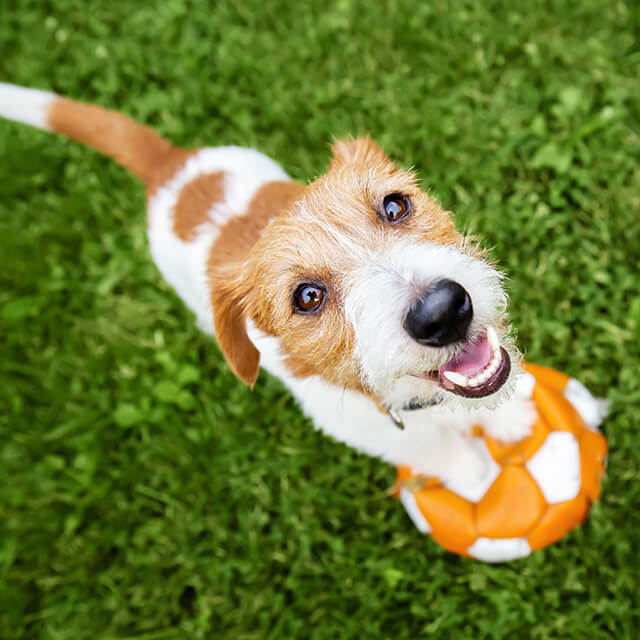
If your pup seems to struggle to find its favourite red ball in the grass, it’s because of this red-green colour blindness.
Dogs generally have less precise visual understanding than we do, so they have difficulty distinguishing fine details at a distance.
But one excellent thing you might have noticed as a dog parent is that they excel at detecting movement, even in low-light conditions. This enhanced motion sensitivity is an evolutionary advantage of their hunting ancestry, and relies on the reflective layer behind the retina, known as the tapetum lucidum, which gives dogs their low-light advantages and makes their eyes shine in torchlight.
Dogs typically have around 20/75 acuity compared to our 20/20. As a result of this 20/75 dog vision, they struggle to see things within about 10cm of their face, and this is when they rely on their sense of smell and use their mouth to touch and explore.
We know that dogs see differently to humans, but how? Well, there are two main ways we’ve come to understand how dogs see:
Like a human baby, as a dog grows up, its eyesight will develop and change over time.
You can expect your puppy to go through four major stages of development that look like so:
Movement detection and general visual awareness mature alongside colour perception, and don’t arrive all at once.
Interestingly, eyesight or vision varies across dog breeds. Genetics largely set the baseline for a dog’s vision and also determine their risk of inherited eye conditions.
Brachycephalic breeds (those with short, flattened muzzles) may have a more restricted field of vision. This is because of the way their eyes are positioned.
Sighthounds, like greyhounds, are well-known for their superior long-distance vision and wide visual field.
Different breeds can be prone to different eye conditions, Border Collies for example are prone to progressive retinal atrophy or Collie eye anomaly.
If you are considering getting a puppy, research the dog breed and where recommended, ask the breeders to see certificates confirming good eye health of the parents.
You can help support your dog's eye health by giving them foods rich in antioxidants, like carrots and blueberries. Cleaning around your dog’s eyes gently using moist cotton wool and grooming your dog so as to keep hair around the eyes trimmed are also great ways you can look after your dog.
It's also great to speak to your veterinarian about a quality dog multivitamin that includes eye-supporting nutrients. In fact, you should take your dog to see the veterinarian for routine eye checks every year.
You should also ensure they are fed complete and balanced dog food tailored to their life stage and all the nutrients they need to support everyday health and vitality.
Keeping a low lamp on in dim areas can provide your dog with an added layer of comfort, but you should avoid flickering or twinkling lights in any room that your dog sleeps in.
If you notice red, cloudy, or watery eyes, see excessive discharge coming from your dog's eyes, or observe your dog rubbing at their eyes, you should take them to see a vet.
Before choosing any toys or bowls for your dog, you should consider the following:
Dogs have dichromatic vision, which means that they do see colours, just not as wide a range as humans can see. They primarily see in blues, yellows, and greys, for example, colours like red are seen more as a brown or dark grey. However, it is contrast that aids their sight more than any colour vision.
Blue and yellow. This is because a dog's eyes carry more receptors for those wavelengths than any other. But what helps them see most is contrast between colours rather than the colours themselves.
Grass appears as a brownish-yellow to dogs rather than green. This is because red and green are the two colours dogs cannot separate, which can explain why they may struggle to find a red ball amongst the grass.
Dogs don’t actively avoid any colours, but red is the hardest for a dog to pick out, as it reads only as a dull brown, grey, or near-black colour against most backgrounds. Blue and yellow tend to be the easiest colours for dogs to see because they are more vibrant against duller backgrounds which allows a greater contrast.
No. Puppies are born with their eyes closed, opening them at 10–14 days. They begin to see colours more clearly at around eight weeks, but won’t have full adult-like vision until they are six months old.
Dogs can see better than we do in dim light, but not in total darkness. This is due to them having more rod cells, and a specially adapted reflective layer behind their retinas known as the tapetum lucidum.
You can find more dog health advice here.
Buy Now
Click to buy from any of the retailers below