Written in collaboration with vets

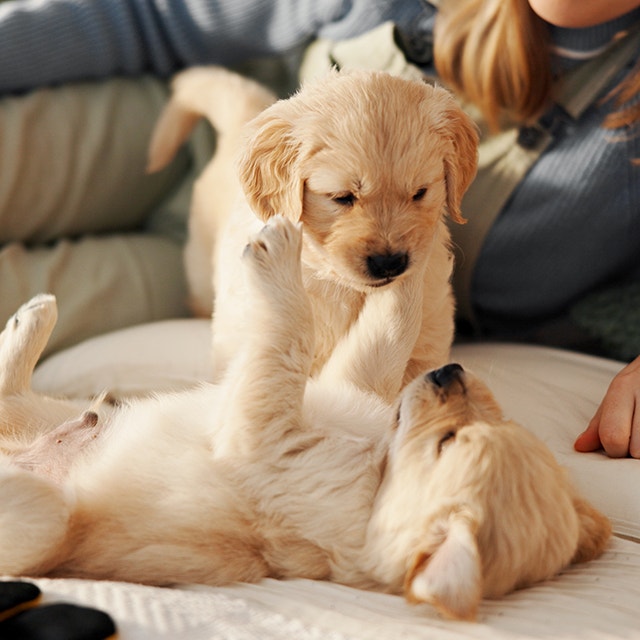

Bringing home a new puppy is a wonderful experience; there is so much excitement, joy, but also a lot of unknowns. You may still be unsure about exactly what to expect when it comes to raising a puppy. This guide will help you to understand the five puppy development stages and how to best navigate them, so that your puppy grows up to be a well–behaved dog.
The five puppy development stages are:
The exact length of the puppy development stages can vary depending on the size and breed of your dog. Generally, smaller breeds tend to mature quickly than larger breeds.
Effective socialization and training protocols are key to your puppy developing into a well-mannered dog.
By the end of this guide, you’ll know exactly what to expect when it comes to puppy development by week.
Scientific research proves that growing puppies have different nutritional needs to adult dogs. To give your puppy the best start towards a long and healthy life, it’s important to provide them with a diet that’s specifically designed for puppies throughout the growth phase. The length of this phase will depend on the size of the dog with smaller breed puppies maturing much more quickly than larger breeds.
Early socialisation and training experiences leave a positive, lasting impression on a puppy and helps them to develop into a well-mannered adult dog. The development of puppies can be divided into five distinct stages:
Through this period puppies are relatively helpless, relying entirely on their mother.
At this stage, the puppy spends the majority of its time either sleeping or eating. Puppies’ eyes and ears are closed when they’re born but they are sensitive to touch and smell. Their eyes open at around 10-14 days old but puppies do not respond to light and moving stimuli until the transitional period (two to three weeks of age).
This is arguably the most precarious of all the puppy development stages, as the puppies are entirely reliant on their mother for warmth and nutrition. They will spend the majority of their time either eating or sleeping to build up their strength. A big reason for this is that puppies are born with their eyes and ears shut, they open between 10–14 days after birth. However, they are sensitive to touch and smell and don’t respond to light and movement-based stimuli until the transitional period. This occurs between 2–3 weeks of age.
Any attempts to handle puppies during this point in the puppy timeline should be careful, gentle, and limited to help avoid or minimize stress.
At this point in the puppy timeline, their eyes and ears open, and they begin to explore their immediate surroundings using their newfound senses. They also start interacting with their siblings and begin to develop basic body coordination, so they’ll be a little unsteady moving around during this stage.
This is the section of the puppy timeline where socialisation begins. You can begin picking them up gently to let them experience what it’s like to be held, so that they’re comfortable with it later on in their lives. You can also begin to gradually introduce them to family members and friends who will be a part of their lives as they age. This will help them become confident if they are ever looked after by one of these people.
This is probably the most influential period of your puppy’s life and much of what is learned during this period may last throughout their life. During this time they develop social skills and learn about their environment. It’s essential during the later part of this period that they encounter as many of the people, objects and situations they might encounter in later life, including being left alone for short periods, visiting the vet and travelling in the car.
This is arguably the most crucial of all the puppy stages, as the habits that are instilled into them during this period will be carried on throughout their lives. They will do more exploring as they become more curious about their surroundings. They will also become more playful as they learn to communicate with you and others using sound and body language.
Within the Socialization Stage, there will be ‘mini puppy stages’ or milestones which include:
During the latter part of this stage, it is important that they encounter and have good experiences with all the people, environments, and objects it is likely to come across throughout their life. It’s recommended that you leave them alone for short periods of time to get them used to you not being there, and ensure that you take them with you in your preferred mode of transport. You can also take your puppy to visit a family member’s house to help them acclimatize to a new environment they will frequently visit.
The Early Training Stage can be one of the most enjoyable of the puppy stages, as it’s when you finally get the opportunity to begin teaching your puppy to do things.
Building and maintaining a consistent low—stress routine for your puppy is the foundation for all of your training methods. A consistent routine will go a long way towards helping them to feel confident, which helps them to attempt and achieve more tasks.
At this stage, you’ll begin to toilet train your puppy and use positive reinforcement during training sessions. This will help shape positive behaviour in the long term.
During the Early Training stage, it’s also common for your puppy to have challenges such as separation anxiety and nipping. It may help if you create, or get help to create, a training plan so you can track your puppy development by week.
At this point in the puppy timeline, you will see them grow rapidly in terms of physical size and personality. They’ll also begin to test your boundaries by ignoring your commands, and resource guarding objects such as food, toys and clothing.
This is usually a good time to discuss with your vet the neutering/spaying options for your puppy. Veterinary guidance is also important to ensure their specific dietary needs are met, so that they continue to grow at the appropriate rate.
Teething and nipping is also still common at this stage.
This is arguably the most frustrating of all the puppy development stages. This is because even though they are reaching physical maturity, they still haven’t quite reached mental maturity. They’ll want to show off to others and see off any competition. Your challenge is to balance allowing your dog more freedom whilst avoiding uncomfortable situations with other dogs/dog owners.
They can become quite stubborn and test your boundaries even more during this stage.
At this stage, the following elements are vital:
All of the above elements, along with a lot of patience from you, will play a significant part in your puppy becoming a wonderful, well-mannered dog. This is a tough stage, but it doesn’t last forever, and the rewards for persevering are wonderful.
After all the hard work you’ve put into your puppy’s training, your dog’s adolescence can be a frustrating time.
Instinct is telling your dog that it is time to get out and about, showing off, leaving their scent everywhere and seeing off competition. Your challenge is to allow your dog some freedom without getting into too many uncomfortable situations with other dogs and their owners.
When adolescent dogs challenge each other, a scuffle is almost inevitable, but it’s very unlikely to result in injury. Once one has established itself as ‘top dog’, the fight usually ends in a few seconds. And a part of adolescence is learning the rules. So you don’t need to keep your adolescent apart from other dogs – they’ll simply grow up frustrated and poorly socialised. (Properly socialised puppies will “mock bite” without causing injury – if yours does injure another, they will need specialist “bite inhibition” training.)
At this time, it’s essential to keep working on every aspect of your dog’s training: give them lots of praise and rewards to boost their self-esteem while they work off some of their extra energy. Don’t give up – adolescence won’t last forever.
It depends on your specific circumstances. However, some dog owners may say the Adolescent stage due to the increase in stubbornness in puppies.
It is a guide that says when potty training, you should give your puppy:
However, there is no scientific evidence that this is the best method. Each puppy is an individual, and you will soon work out what’s best. Please consult a vet for more specific information for your puppy.
The hardest months with a dog depend on your individual circumstances. These factors can include your dog’s breed, your location, and the type of training you’re able to provide.
This is a general, non-scientific rule for puppies adjusting to a new home. It’s broken down into:
Buy Now
Click to buy from any of the retailers below